
October 27, 2026
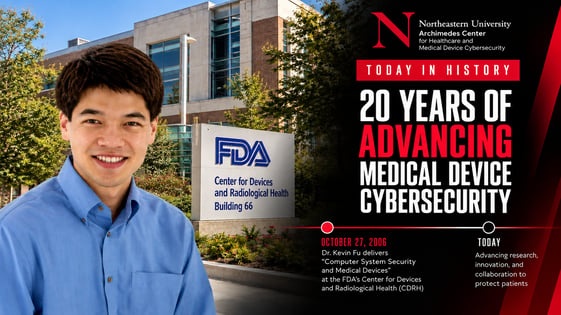 Twenty years ago, as medical devices became increasingly dependent on software and connectivity, a critical question was emerging: How could healthcare technology be protected against cybersecurity threats while safeguarding the patients who depend on it?
On October 27, 2006, Dr. Kevin Fu, now Director of the Archimedes Center for Healthcare and Medical Device Cybersecurity at Northeastern University, delivered a presentation titled “Computer System Security and Medical Devices” at the U.S. Food and Drug Administration's (FDA) Center for Devices and Radiological Health (CDRH). The presentation was an early contribution to a growing body of research examining the intersection of computer security, medical technology, and patient safety.
Two decades later, medical device cybersecurity has evolved from an emerging research concern into a fundamental component of medical device design, healthcare operations, and regulatory oversight. As artificial intelligence accelerates both technological innovation and the evolution of cyber threats, the urgency of advancing this work has never been greater.
Two Decades of Progress in Medical Device Cybersecurity
The healthcare technology landscape has transformed dramatically over the past 20 years. Medical devices have become more sophisticated, interconnected, and software-driven, creating extraordinary opportunities to improve patient outcomes while introducing new cybersecurity risks.
From implantable devices and patient monitoring systems to network-connected hospital equipment, cybersecurity vulnerabilities can affect far more than information security. They can disrupt clinical operations, compromise device functionality, and potentially threaten patient safety.
During this period, advances in cybersecurity research, industry practices, and regulatory policy have reshaped how medical devices are developed, deployed, and maintained. Security by design, coordinated vulnerability disclosure, software supply chain transparency, and lifecycle risk management have become increasingly important elements of medical device cybersecurity.
The FDA's evolving cybersecurity guidance and regulatory requirements reflect this transformation, reinforcing the importance of addressing cybersecurity throughout a device's lifecycle.
Advancing Research, Innovation, and Collaboration
Dr. Fu's pioneering research and leadership have helped establish medical device cybersecurity as a critical discipline at the intersection of engineering, computer science, medicine, and public policy.
Today, the Archimedes Center at Northeastern University advances this work through research, innovation, education, and collaboration with healthcare organizations, medical device manufacturers, government agencies, and cybersecurity experts.
The Center brings together diverse perspectives to address practical security challenges affecting medical technology and the healthcare environments in which it operates. Its work connects foundational research with real-world applications, helping strengthen the security and resilience of medical devices and healthcare systems.
An important part of this mission is cultivating the next generation of researchers and innovators. Through hands-on research and engagement with the broader cybersecurity community, students contribute to advancing security technologies and addressing emerging threats.
From Foundational Research to Scalable Cybersecurity Solutions
Despite significant progress, medical device cybersecurity remains a complex challenge. Healthcare organizations depend on diverse fleets of connected devices, including legacy technologies that can be difficult to update. Security vulnerabilities must often be addressed in environments where device downtime is impractical and uninterrupted patient care is essential.
Meeting these challenges requires approaches that make cybersecurity more proactive, scalable, and compatible with clinical operations.
One example is the Archimedes Center's PATCH Project, led by Dr. Fu. PATCH is developing tools to accelerate the discovery and remediation of cybersecurity vulnerabilities in medical devices while minimizing disruption to patient care. The project represents an important step toward more automated, efficient, and scalable approaches to protecting healthcare technology.
The initiative demonstrates how advances in cybersecurity research can translate into practical solutions for some of healthcare's most pressing security challenges.
The Next Three Years: A Critical Window for Medical Device Cybersecurity
The next three years could be among the most consequential for medical device cybersecurity. Artificial intelligence is accelerating technological innovation while simultaneously changing the nature, speed, and sophistication of cyber threats.
As healthcare systems become more connected and medical devices increasingly rely on software, the potential attack surface continues to expand. AI-enabled tools may make it easier for malicious actors to identify vulnerabilities, automate elements of cyberattacks, and exploit weaknesses at greater speed and scale. Even isolated attacks against vulnerable medical technologies could have serious implications for clinical operations, device availability, and patient safety.
These risks are particularly significant in healthcare environments, where devices often remain in service for many years, security updates can be difficult to deploy, and uninterrupted patient care is essential.
The challenge is no longer simply identifying cybersecurity vulnerabilities. It is finding and addressing them faster than they can be exploited, without disrupting the delivery of care.
This is why research initiatives such as PATCH are so critical. Advances in automated vulnerability discovery, secure remediation, and scalable cybersecurity technologies can help healthcare organizations move from reactive responses toward more proactive protection.
Over the next three years, progress will depend on accelerating the translation of research into practical solutions, strengthening collaboration across industry, academia, healthcare, and government, and preparing the next generation of cybersecurity researchers to address rapidly evolving threats.
Building on 20 Years of Progress
The 20th anniversary of Dr. Fu's 2006 FDA presentation is an opportunity to recognize how far medical device cybersecurity has advanced and the growing importance of the work ahead.
From foundational research to today's ambitious initiatives, the Archimedes Center remains committed to advancing the science, technology, and collaboration needed to protect medical devices and the patients who depend on them.
Twenty years of progress have established the foundations. The next three years will demand unprecedented speed, innovation, and collaboration.
We invite researchers, healthcare leaders, medical device manufacturers, policymakers, and cybersecurity professionals to help advance this critical work.
Explore our research, discover opportunities to collaborate, and join the Archimedes community at secure-medicine.org.